Tag: Cheap VPS Romania

  • Cheap VPS Romania: How to Choose an NVMe Plan Without Overpaying

    Cheap VPS Romania: How to Choose an NVMe Plan Without Overpaying

    Budget VPS plans can be excellent if you choose based on workload, not only monthly price. This guide helps you select a cheap NVMe VPS in Romania while keeping enough headroom for real traffic.

    What to evaluate before price

    • Storage type: NVMe changes responsiveness for app and database workloads.
    • CPU generation and contention risk under peak usage.
    • Local latency for your user base.
    • Clear, simple upgrade path when demand increases.

    Common low-cost mistakes

    • Buying minimum RAM for production WordPress.
    • Ignoring background jobs and cron impact.
    • No monitoring, then upgrading only after incidents.
    • Over-buying from day one without validated demand.

    Plan sizing pattern that works

    Start with 1 GB only for lean and predictable workloads. Use 2 GB as default for most production web apps. Move to 4 GB when real monitoring data confirms sustained pressure.

    Validation checklist before launch

    free -m
    vmstat 1 5
    iostat -x 1 3
    curl -I https://your-domain
    
    • Keep RAM below saturation during normal traffic.
    • Watch swap behavior during updates and backup windows.
    • Validate response time from user-relevant regions.

    Related guides

    FAQ

    What is the best cheap VPS plan for starting a project?

    For many production workloads, 2 GB is the safest start. Use 1 GB only when the stack is intentionally minimal.

    Is NVMe worth it on budget plans?

    Yes. NVMe improves I/O-heavy tasks like package installs, cache warmups, and database operations.

    How do I avoid overpaying?

    Start with measured requirements, monitor usage weekly, and scale only when metrics confirm sustained pressure.

    Related comparison guides

  • Cheap 1 GB VPS Use Cases and When to Upgrade

    Cheap 1 GB VPS Use Cases and When to Upgrade

    A 1 GB RAM NVMe VPS is still a strong option for lean workloads. If you keep the stack simple, optimize memory limits, and avoid plugin bloat, a 1 GB plan can run reliably and cheaply.

    This guide shows what fits well on 1 GB, what usually fails, and how to know exactly when moving to 2 GB is the right business decision.

    What runs well on a cheap 1 GB VPS

    • WireGuard VPN, SSH jump hosts, bastion and internal tooling.
    • Static websites (Nginx, Caddy, Hugo) and landing pages.
    • Small APIs and bots (FastAPI, Flask, Node micro services).
    • Lightweight CI helpers, cron jobs, webhooks and monitoring agents.
    • Developer playground environments with one main process at a time.

    Memory budget example for 1 GB

    • Operating system baseline: 180 to 260 MB.
    • Web server and runtime: 200 to 350 MB.
    • Small database or cache: 150 to 250 MB.
    • Safety margin: 150 to 250 MB.

    With careful tuning, this can work. Without tuning, 1 GB gets unstable quickly under concurrent requests.

    Minimal production stack (lean and stable)

    sudo apt update
    sudo apt install -y nginx ufw fail2ban
    # Add only what you need next: runtime, database, certbot
    

    Start small. Add services only after measuring resource impact.

    Optimization checklist before you upgrade

    • Use one web stack only (for example Nginx + PHP-FPM) and remove unused services.
    • Reduce worker counts to match real traffic.
    • Enable caching where possible.
    • Disable plugins, modules, and daemons you do not use.
    • Set alerts for RAM usage, swap growth, and disk pressure.

    When 1 GB is no longer enough

    • RAM is consistently above 85 percent during normal traffic.
    • Swap increases daily even after service tuning.
    • WordPress admin becomes slow with multiple plugins.
    • Background jobs delay user-facing requests.
    • You need two or more containers running all the time.

    Upgrade path that avoids downtime

    1. Lower DNS TTL to 300 seconds before migration day.
    2. Provision a 2 GB VPS and prepare the same runtime versions.
    3. Sync files and database, test with hosts override.
    4. Switch DNS and monitor logs for 24 to 48 hours.

    Detailed migration walkthrough: Migrate a 20i VPS to TinyServers NVMe with Zero Downtime.

    Recommended plans

    Related reading

    Quick FAQ

    Can I run WordPress on 1 GB?

    Yes, for simple websites with strict plugin control. Heavier themes or WooCommerce usually need 2 GB.

    Is 1 GB enough for Docker?

    For one or two tiny containers, yes. For multiple always-on containers with queues, upgrade to 2 GB.

    What is the biggest mistake on 1 GB?

    Running too many services at once without memory limits and monitoring.

    Three practical 1 GB deployment patterns

    1) VPN and secure access node

    WireGuard plus a hardened SSH setup is an excellent low-cost use case. Memory usage stays predictable and performance is consistent.

    2) Static marketing site + status page

    Nginx serving static content with TLS and basic monitoring can run for months with very low resource usage.

    3) Lightweight webhook worker

    A single runtime process that handles webhooks, queues small jobs, and writes minimal logs can fit comfortably on 1 GB.

    Cost control and reliability tips

    • Pin package versions for critical services to avoid surprise memory jumps.
    • Rotate logs aggressively to protect disk and memory cache behavior.
    • Use simple health checks and automatic restart policies.
    • Document a clear upgrade runbook before traffic growth arrives.

    For teams expecting growth in the next quarter, starting on 2 GB can be cheaper than repeated firefighting on 1 GB.

    Intent Hub Links

  • NVMe VPS Romania Benchmarks and Speed Tests (Sep 2025)

    NVMe VPS Romania Benchmarks and Speed Tests (Sep 2025)

    Last updated: 01 Mar 2026
    Location: Bucharest, Romania
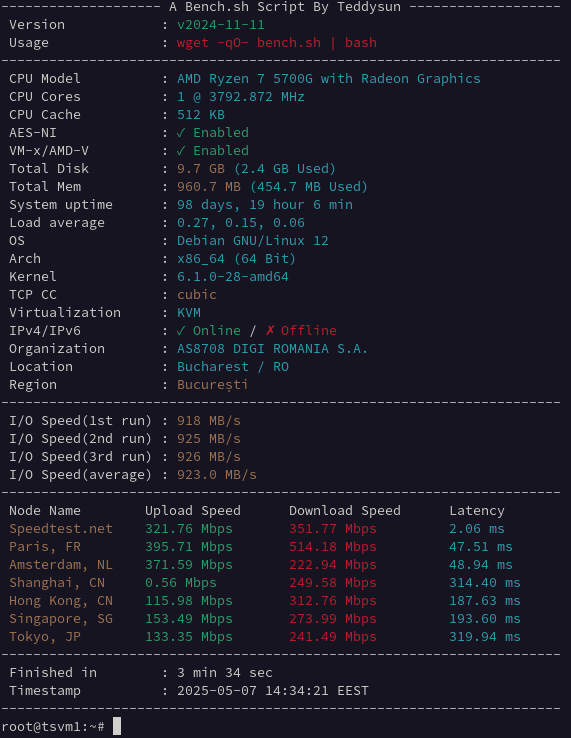
    Host platform: AMD Ryzen 5700G nodes with NVMe storage
    Network port: up to 1 Gbps

    This page is the benchmark hub for TinyServers NVMe VPS plans in Romania. The goal is simple: publish reproducible performance data, explain what those numbers mean in practice, and map each workload to the right VPS size.

    Benchmark methodology

    • Fresh VPS deployment before each test cycle.
    • No custom kernel tuning unless explicitly stated.
    • Each network and disk test run multiple times, median reported.
    • Tools used: speedtest, fio, and standard Linux monitoring commands.
    • Tests executed at comparable times to reduce peak-hour variance.

    How to reproduce locally

    sudo apt update && sudo apt install -y speedtest-cli fio
    speedtest
    fio --name=randread --ioengine=libaio --rw=randread --bs=4k --size=1G --numjobs=1 --iodepth=32 --direct=1
    

    If you run your own tests, use at least three runs and compare medians, not single spikes.

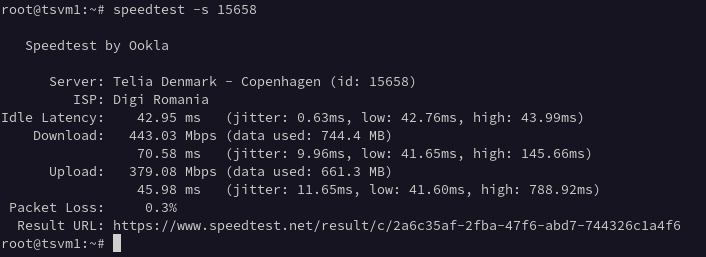
    Recent network snapshots

    Month Download Upload Latency Plan
    Sep 2025 384 Mbps 450 Mbps 2.1 ms TSM1NVME10
    Aug 2025 443 Mbps 379 Mbps 8.4 ms TSM1NVME10

    Network throughput changes by destination, peering, and time of day. Use these values as realistic references, not fixed guarantees.

    How to interpret benchmark numbers

    CPU

    For web applications, CPU matters most during concurrent dynamic requests, compression, and background processing. If response times degrade under moderate concurrency, move to a plan with more vCPU headroom.

    Disk I/O (NVMe)

    Fast disk I/O improves package updates, database operations, cache warmup, and deployment time. For CMS and API workloads, strong NVMe performance is often the difference between smooth and inconsistent behavior under spikes.

    Network

    Low latency to local users improves page responsiveness and API round-trip times. Throughput is more visible during file transfer, media delivery, and backup windows.

    Workload mapping by plan size

    • 1 GB RAM: VPN, static sites, lightweight API endpoints, low-traffic tools.
    • 2 GB RAM: WordPress with plugins, small production APIs, app + database combinations.
    • 4 GB RAM: higher concurrency, more workers, larger caches, multiple always-on services.

    For most new production projects, 2 GB is the safest starting point because it avoids early memory bottlenecks while keeping cost low.

    Detailed benchmark articles

    Choose your VPS plan

    Benchmark update policy

    • New measurements are added after major infrastructure or routing changes.
    • When a metric changes significantly, methodology notes are updated on this page.
    • Older data points remain visible for historical comparison.

    Quick FAQ

    Are benchmarks enough to choose a VPS?

    They are a strong starting point, but real usage profile matters more than a single synthetic score.

    Why can my speedtest differ from published results?

    Route selection, test endpoint, and time of day can change throughput and latency.

    What is the safest default for new production projects?

    Most teams should start with 2 GB NVMe and scale up when monitoring shows sustained pressure.

    How benchmarks map to real workloads

    Workload type Main bottleneck Metric to watch first
    CMS websites Memory and database I/O RAM pressure + disk latency
    API backends CPU concurrency Response time under parallel load
    Backup and transfer jobs Network throughput Upload/download consistency

    Benchmark caveats and good practice

    • Single speedtest results can be misleading; use medians and multiple endpoints.
    • Do not compare different providers without normalizing region and test method.
    • Measure during your own peak business window, not only off-peak hours.
    • Validate synthetic benchmarks with application-level metrics.

    Decision matrix for fast plan selection

    • Choose 1 GB when budget is strict and workload is simple.
    • Choose 2 GB for production WordPress, APIs, and mixed app stacks.
    • Choose 4 GB when you need higher concurrency and wider safety margins.

    Need migration help while scaling? Follow the zero-downtime migration guide: How to migrate to TinyServers NVMe VPS.

    Commercial Intent Guides