Tag: VPS Plan Comparison

  • 1 GB vs 2 GB vs 4 GB VPS: Which Plan Fits Your Workload?

    1 GB vs 2 GB vs 4 GB VPS: Which Plan Fits Your Workload?

    Choosing the right VPS size is one of the biggest decisions for cost and stability. This guide compares 1 GB, 2 GB and 4 GB NVMe VPS plans using practical workloads instead of generic specs.

    Quick decision table

    Plan Best for Main risk Upgrade signal
    1 GB RAM VPN, static sites, tiny APIs Low memory headroom Frequent swap or RAM over 85 percent
    2 GB RAM WordPress, small production apps Worker contention at peaks Queue lag, plugin-heavy workloads
    4 GB RAM Higher concurrency, multi-service stacks Higher monthly cost Needed when 2 GB stays saturated

    1 GB VPS profile

    A 1 GB plan is ideal when you keep the stack lean and predictable. It works best for low-traffic services and utility workloads.

    2 GB VPS profile

    For most small production apps, 2 GB is the safest default. You get enough memory for caching, moderate concurrency, and cleaner deployments.

    4 GB VPS profile

    Move to 4 GB when your project is already proven and bottlenecks are recurrent, not occasional.

    How to decide in 10 minutes

    1. List always-on services and estimated peak memory.
    2. Check expected concurrency and background jobs.
    3. Start one tier higher if your business cannot tolerate slowdowns during spikes.

    Benchmark reference

    Before buying, check real measurements from the same infrastructure: NVMe VPS Romania benchmarks.

    FAQ

    Is 1 GB enough for production?

    Yes for lean workloads. For plugin-heavy WordPress or multi-service setups, 2 GB is usually safer.

    When should I jump from 2 GB to 4 GB?

    When monitoring shows sustained high RAM usage, queue lag, or repeated swap under normal traffic.

    Which plan gives best price-performance?

    For many small production projects, 2 GB offers the strongest balance between cost and stability.

    More decision guides

  • Is a 2 GB VPS Enough? Best Use Cases, Performance and When to Choose 4 GB

    Is a 2 GB VPS Enough? Best Use Cases, Performance and When to Choose 4 GB

    A 2 GB VPS is often the best balance between price and usable performance for small production workloads. It gives you more headroom than a 1 GB VPS, while still keeping monthly costs low. For many websites, lightweight applications and small business services, 2 GB RAM is a practical starting point.

    If you need a VPS for a small WordPress site, a control panel, a few light services or a development stack that should feel stable under normal use, 2 GB RAM is usually the safer choice. It is a better fit than 1 GB when the server is not just for testing, but for something that people actually rely on.

    Good use cases for a 2 GB VPS

    A 2 GB VPS is a strong fit for:

    • small to medium WordPress websites
    • websites with moderate traffic
    • development and staging environments
    • bots, automation and API services
    • small control panel installs
    • lightweight Docker setups
    • VPN, proxy or monitoring servers with extra headroom

    Compared to 1 GB RAM, a 2 GB VPS is more forgiving. You have more space for the operating system, background services and traffic spikes without hitting memory limits as quickly.

    When 2 GB RAM is enough

    A 2 GB VPS is usually enough when:

    • you run one main website or application
    • your traffic is still moderate
    • your plugins or services are not heavy
    • you want a stable small production environment
    • you need room for growth without jumping straight to a larger plan

    For many users, this is the point where a VPS stops feeling entry-level and starts feeling practical for real workloads.

    When you should choose 4 GB instead

    You should usually start with 4 GB RAM if you plan to run:

    • multiple active websites
    • heavier WordPress installs
    • larger databases
    • several Docker containers
    • memory-hungry control panels
    • busier ecommerce or client projects

    If you already know the workload is commercial, heavier or expected to grow soon, 4 GB will give you more margin and reduce the need for an early upgrade.

    2 GB VPS vs 1 GB VPS

    Choose a 1 GB VPS if:

    • you want the lowest cost
    • the project is small
    • you are testing, learning or running a single lightweight service

    Choose a 2 GB VPS if:

    • the server matters for real users
    • you want better stability
    • you need more room for plugins, services or background tasks
    • you want a better balance between cost and performance

    For most small production workloads, 2 GB RAM is the more practical default.

    2 GB VPS vs 4 GB VPS

    Choose 2 GB RAM if:

    • you need a budget-friendly production VPS
    • you run one main service
    • the workload is still relatively light
    • you want a safe upgrade from 1 GB

    Choose 4 GB RAM if:

    • you run multiple services
    • you need more performance margin
    • you want to reduce upgrade pressure
    • your workload is already business-critical

    How to choose the right plan

    If you are choosing between 1 GB, 2 GB and 4 GB, think in terms of risk:

    • 1 GB is best for lightweight and non-critical workloads
    • 2 GB is best for small production use
    • 4 GB is best when stability, growth and flexibility matter more

    For many users, 2 GB VPS is the sweet spot because it keeps costs reasonable while giving enough RAM for a much wider range of real use cases.

    Need help choosing?

    A 2 GB VPS is often the right starting point if you want something affordable but usable for real traffic and daily workloads. If the project is very small, 1 GB may still be enough. If you already expect higher load or multiple services, start with 4 GB.

    View available plans here:

    Quick FAQ

    Is 2 GB RAM enough for WordPress?

    Yes. For many small to medium WordPress websites, 2 GB RAM is a solid starting point, especially with caching and a lightweight setup.

    Can I run a control panel on a 2 GB VPS?

    Yes, for lighter setups. If you expect multiple hosted sites or heavier usage, more RAM may be needed.

    Is 2 GB VPS enough for Docker?

    Yes, for small Docker workloads. For several containers or memory-heavy services, 4 GB is safer.

    Should I choose 2 GB or 4 GB?

    Choose 2 GB for small production workloads and 4 GB when you expect heavier usage, more services or faster growth.

    Need a VPS that is still affordable but strong enough for real workloads? A 2 GB NVMe VPS is often the best place to start.

  • NVMe VPS Romania Benchmarks and Speed Tests (Sep 2025)

    NVMe VPS Romania Benchmarks and Speed Tests (Sep 2025)

    Last updated: 01 Mar 2026
    Location: Bucharest, Romania
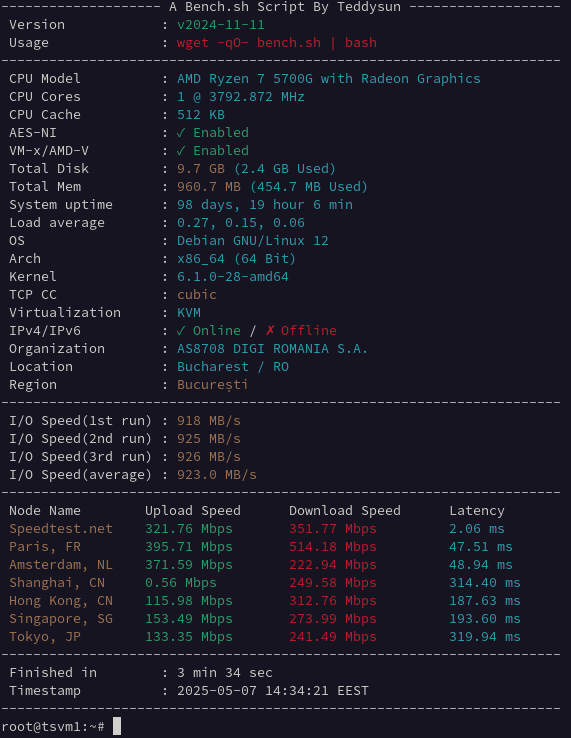
    Host platform: AMD Ryzen 5700G nodes with NVMe storage
    Network port: up to 1 Gbps

    This page is the benchmark hub for TinyServers NVMe VPS plans in Romania. The goal is simple: publish reproducible performance data, explain what those numbers mean in practice, and map each workload to the right VPS size.

    Benchmark methodology

    • Fresh VPS deployment before each test cycle.
    • No custom kernel tuning unless explicitly stated.
    • Each network and disk test run multiple times, median reported.
    • Tools used: speedtest, fio, and standard Linux monitoring commands.
    • Tests executed at comparable times to reduce peak-hour variance.

    How to reproduce locally

    sudo apt update && sudo apt install -y speedtest-cli fio
    speedtest
    fio --name=randread --ioengine=libaio --rw=randread --bs=4k --size=1G --numjobs=1 --iodepth=32 --direct=1
    

    If you run your own tests, use at least three runs and compare medians, not single spikes.

    Recent network snapshots

    Month Download Upload Latency Plan
    Sep 2025 384 Mbps 450 Mbps 2.1 ms TSM1NVME10
    Aug 2025 443 Mbps 379 Mbps 8.4 ms TSM1NVME10

    Network throughput changes by destination, peering, and time of day. Use these values as realistic references, not fixed guarantees.

    How to interpret benchmark numbers

    CPU

    For web applications, CPU matters most during concurrent dynamic requests, compression, and background processing. If response times degrade under moderate concurrency, move to a plan with more vCPU headroom.

    Disk I/O (NVMe)

    Fast disk I/O improves package updates, database operations, cache warmup, and deployment time. For CMS and API workloads, strong NVMe performance is often the difference between smooth and inconsistent behavior under spikes.

    Network

    Low latency to local users improves page responsiveness and API round-trip times. Throughput is more visible during file transfer, media delivery, and backup windows.

    Workload mapping by plan size

    • 1 GB RAM: VPN, static sites, lightweight API endpoints, low-traffic tools.
    • 2 GB RAM: WordPress with plugins, small production APIs, app + database combinations.
    • 4 GB RAM: higher concurrency, more workers, larger caches, multiple always-on services.

    For most new production projects, 2 GB is the safest starting point because it avoids early memory bottlenecks while keeping cost low.

    Detailed benchmark articles

    Choose your VPS plan

    Benchmark update policy

    • New measurements are added after major infrastructure or routing changes.
    • When a metric changes significantly, methodology notes are updated on this page.
    • Older data points remain visible for historical comparison.

    Quick FAQ

    Are benchmarks enough to choose a VPS?

    They are a strong starting point, but real usage profile matters more than a single synthetic score.

    Why can my speedtest differ from published results?

    Route selection, test endpoint, and time of day can change throughput and latency.

    What is the safest default for new production projects?

    Most teams should start with 2 GB NVMe and scale up when monitoring shows sustained pressure.

    How benchmarks map to real workloads

    Workload type Main bottleneck Metric to watch first
    CMS websites Memory and database I/O RAM pressure + disk latency
    API backends CPU concurrency Response time under parallel load
    Backup and transfer jobs Network throughput Upload/download consistency

    Benchmark caveats and good practice

    • Single speedtest results can be misleading; use medians and multiple endpoints.
    • Do not compare different providers without normalizing region and test method.
    • Measure during your own peak business window, not only off-peak hours.
    • Validate synthetic benchmarks with application-level metrics.

    Decision matrix for fast plan selection

    • Choose 1 GB when budget is strict and workload is simple.
    • Choose 2 GB for production WordPress, APIs, and mixed app stacks.
    • Choose 4 GB when you need higher concurrency and wider safety margins.

    Need migration help while scaling? Follow the zero-downtime migration guide: How to migrate to TinyServers NVMe VPS.

    Commercial Intent Guides